Fly any drone.
From anywhere.
On any device.
Dronestream is drone-agnostic ground control that runs in your browser. Plug any phone into any ArduPilot drone with a USB cable. Open a tab. Sign in with a passkey. Launch — over LTE, from any device you carry, from any position you hold.
- Cold start
- 90 s
- Stick-to-prop
- 50–120 ms
- Browser only · any device
- Zero install
- Tamper-proof audit
- Immutable
Three nodes.
One mission.
You operate from a browser. Your phone rides the airframe. A bridge holds the link between them. Each node does one job. None of them need to be installed, imaged, or shipped to you.
- // DS-PORTAL
Operator portal
Your console, in a tab
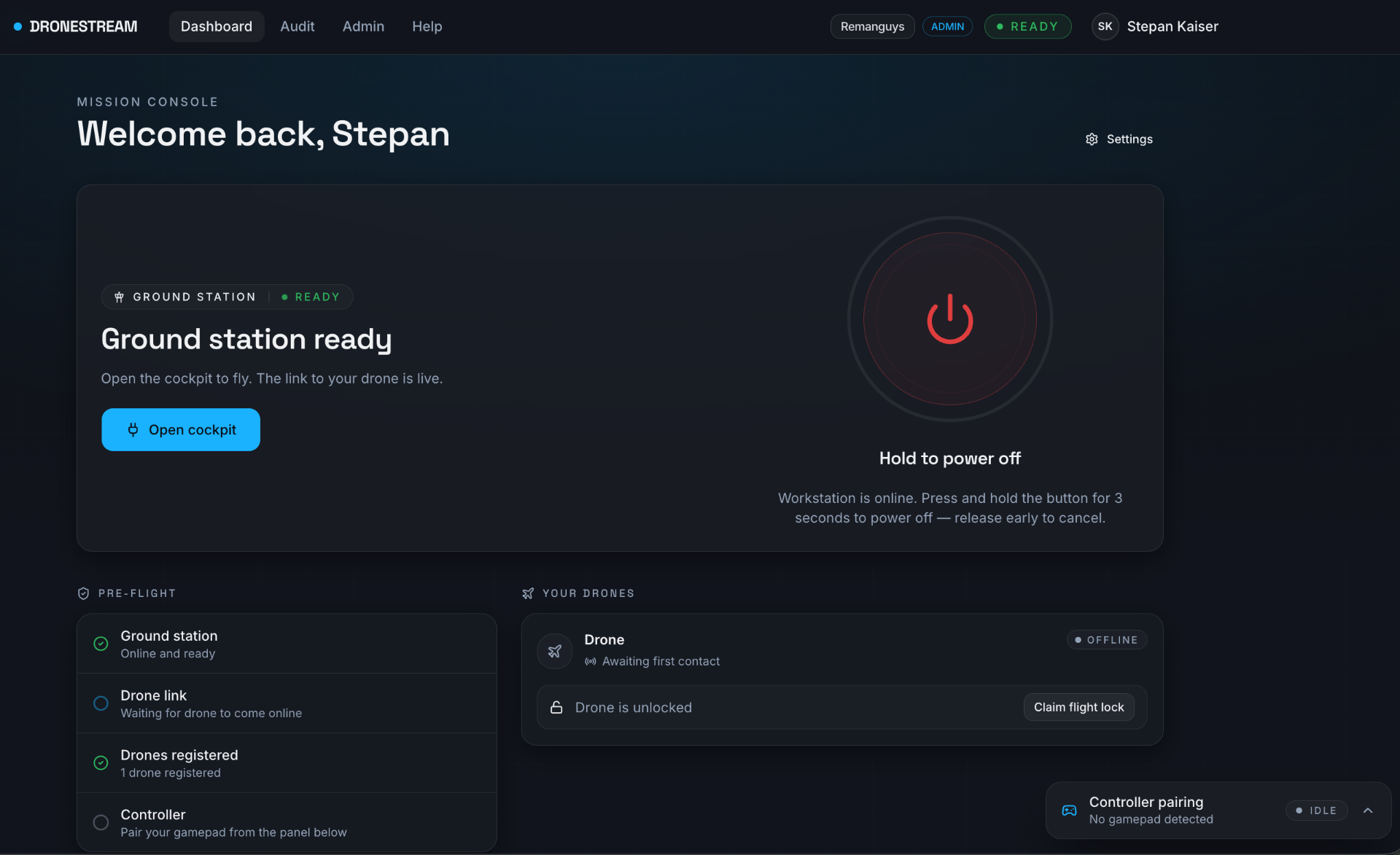
Your console lives in a browser tab. Sign in with a passkey, pick a sortie, fly. No client to install. No image to maintain. No laptop to lose.
- Passkey sign-in, no shared credentials
- Full QGroundControl in the browser
- Gamepad and stick passthrough at 250 Hz
- // DS-PHONE
Your phone
On the drone
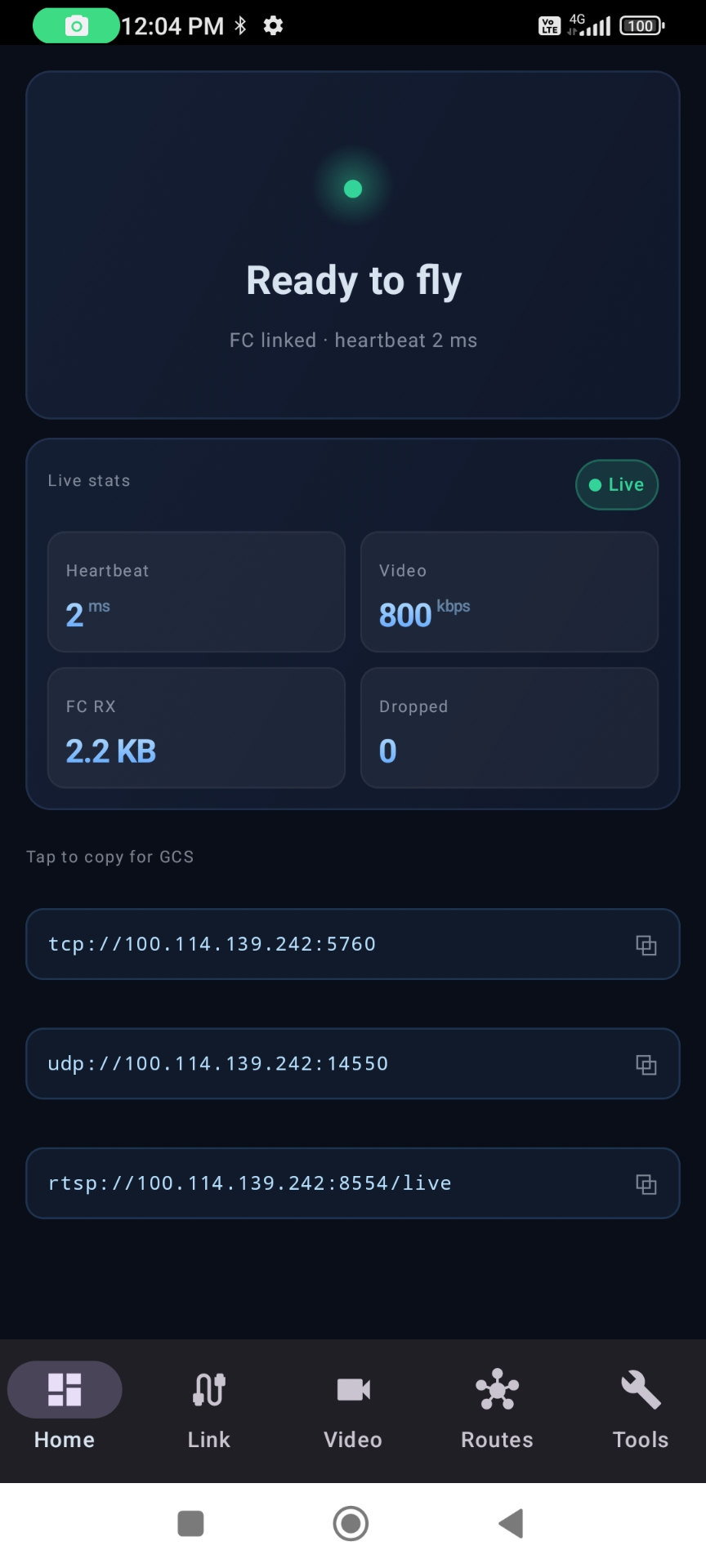
Plug your phone into the drone with a USB cable. Open our app. The phone becomes the airframe's link — it carries telemetry, video, and command frames back to you over LTE or Wi-Fi. No extra hardware. No board to image. The thing in your pocket.
- iOS and Android · USB tether
- ArduPilot-native, any drone
- Auto-reconnect on link loss
- // DS-CTRL
Controller bridge
The part you do not see
The bridge carries every command from your stick to the airframe and every telemetry frame back, inside an EU-hosted control plane. One region. One jurisdiction. One audit trail.
- Stick-to-prop latency, 50 to 120 ms
- EU-hosted control plane, single region
- Immutable session log, write-once
Three hops.
Under 120 ms.
Your stick input crosses three hops before it reaches the airframe: browser to control plane, control plane to the phone on the drone, phone to autopilot over USB. The full path runs 50 to 120 ms end-to-end. You feel a wired stick, not a web app. The number ticks live.
Sovereign by default.
Auditable on demand.
- // AUTH
Passkey access
FIDO2 passkey sign-in. No shared credentials. No password to rotate. No license to transfer between operators on shift.
- // PLANE
EU-hosted control plane
Single region, single jurisdiction. Every command frame transits an EU-domiciled control plane that we operate, not rent.
- // AUDIT
Immutable session log
Every sortie writes to write-once object storage. Tamper-proof, retained for 365 days, readable only by your organisation.
Built for the missions
you actually run.
We do not name our partners on a website. We name the missions. If the shape of one of these is familiar to your unit, the rest of the conversation belongs in a briefing room.
- ISR
Intelligence, Surveillance, Reconnaissance
You hold persistent eyes on a contested area without putting an operator forward of the line. Hand off mid-flight between observers, recover at a different position than you launched from.
- EOD
Explosive Ordnance Disposal & Recon
You inspect, identify, and stand off from suspected devices without exposing the technician. The operator on the stick can be in the next valley or the next country. Render delay does not change.
- PERI
Perimeter & Base Defense
You patrol fixed perimeters around bases, depots, and forward positions on a recurring schedule. Any qualified operator on shift takes control from a browser — no image to push, no license to transfer.
- SAR
Search & Rescue
You launch fast, search wide, and hand control to whoever reaches the survivor first. Sign in on a tablet from a vehicle, take the airframe airborne in under two minutes, pass control once the team is on scene.
- TRN
Operator Training
You qualify new operators on the same console they will fly from on operations. Instructor override on a single keystroke. Full session replay for debrief. Same console for training and operations, no second stack.
Operational
sovereignty.
You can buy a thousand attritable drones tomorrow. You cannot buy a sovereign place to fly them from. The legal regimes that govern hyperscaler infrastructure reach across the Atlantic. They shape what you can be sold, to whom, and on what terms.
The ground control plane — the layer that actually decides whether you lift off this morning — sits inside someone else's jurisdiction by default.
This is not a procurement problem.
It is a sovereignty problem.
You operate drones.
We brief in person.
European armed force, coalition partner, or defense organisation with sovereignty requirements current vendors can't meet — request a briefing. We bring the architecture, the audit posture, and the latency numbers. You bring the mission profile. We meet this quarter.